Midnight Art Club wishes you a very happy 2026
A €100 Picasso and a stolen Picasso: starting 2026 in blue


Welcome to Midnight Art Club, and happy 2026!
Even though the art market held up pretty well in 2025, this week between Christmas and New Year’s things are running a bit slow, and honestly, it feels good. So we’re using the quiet to go back to a classic: Picasso, thanks to a charity raffle built around one of his works… a way to start the year with something other than a hangover :D
OUR SELECTION OF THIS WEEK’S NEWS
• The art world’s Big Three are ticking back up
The three biggest auction houses, a.k.a. the “Big Three”, Sotheby’s, Christie’s and Phillips, brought in around $14 billion in 2025, up roughly 10%. It’s not the craziness of 2022, but at least there’s movement.
• A Picasso for €100, in aid of Alzheimer’s research
A French non-profit is organising a charity raffle at Christie’s in Paris this April around Picasso’s Tête de femme (1941), estimated at over €1 million: tickets are €100 for a chance to win the work and fund Alzheimer’s research.
TO KNOW - The Blue Period: Picasso, free and flat broke
Since we’re talking about Picasso, let’s go back to one of the most famous moments in his career.
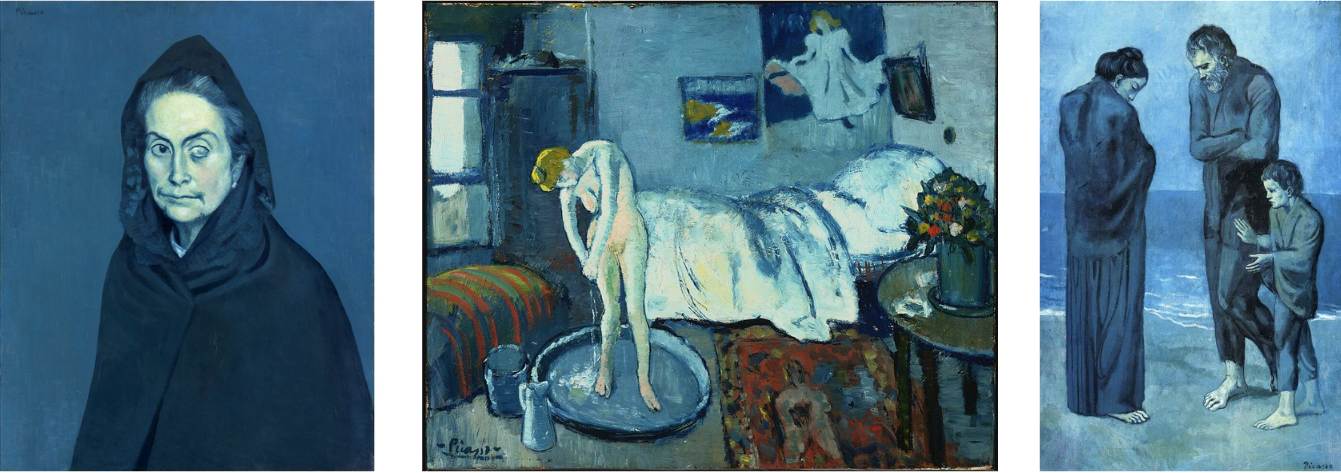
Between 1901 and 1904, Picasso goes through his famous Blue Period: three years when everything turns blue, cold, melancholy… The “official” explanation is the suicide of his friend Casagemas, a huge shock that plunges him into a pretty depressive mood (and yes, the paintings can be a bit depressing too, as you can see below).
Long, elongated figures, blind people, exhausted mothers, heavy scenes of everyday life, not exactly what you’d call ideal living-room painting (speaking just for myself). It’s the moment when, for the first time, he develops a real artistic “voice”: he stops copying and actually starts saying something. See for yourselves:
Why blue, in your opinion?
We often hear that Picasso’s Blue Period is simply the melancholic phase of his life: hence the blue. But some art historians think he was using blue for a more practical reason…
Here’s the context: Picasso is 19 and broke like a student. So if he’s mostly using blue pigment, it’s not just a poetic choice: it was quite simply the cheapest pigment on the market.
And since he couldn’t afford new canvases, X-rays have shown that he literally painted over earlier failed works.
Moral of the story: we like to imagine that masterpieces are perfectly planned, but more often they’re born out of constraints, mistakes and very concrete tinkering. That’s where it gets interesting: when a work becomes the witness of a time and a lived experience.
THE GOSSIP - A Picasso heist… for a good cause?
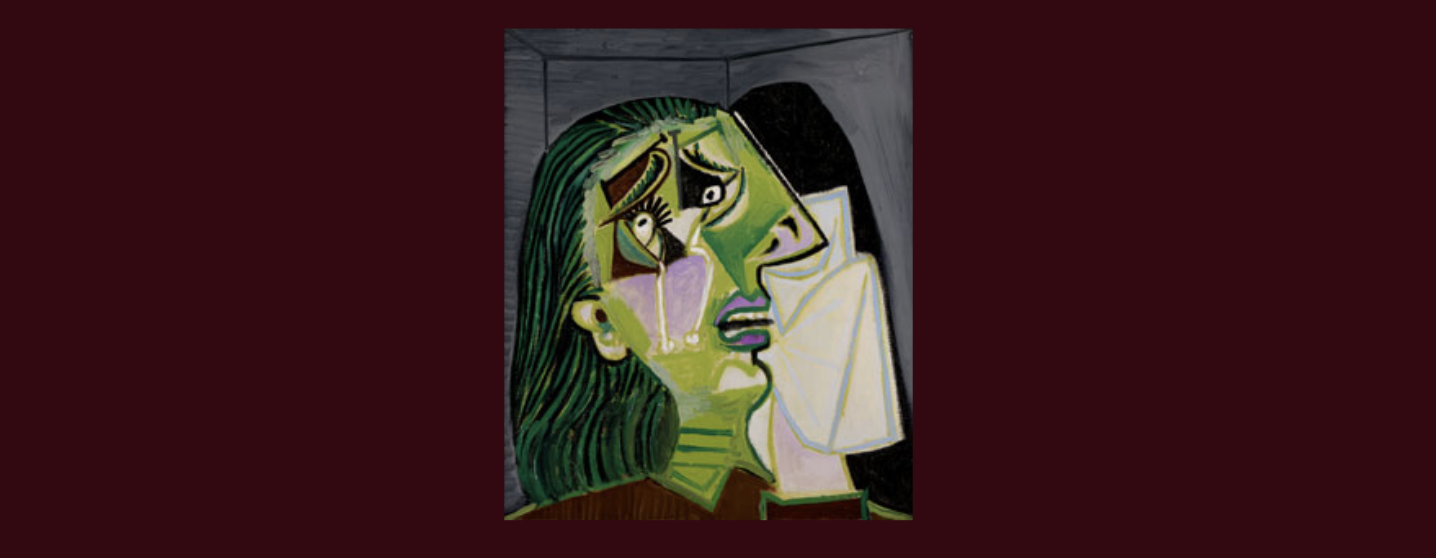
Take a second and picture this: Melbourne, 1986. Not the easiest image to summon, granted, but let’s say big hair, wrinkled suits and a lot of beige. The National Gallery of Victoria has just acquired its absolute trophy, a blazing Picasso, The Weeping Woman, the most expensive purchase ever made by an Australian museum. It’s the star of the collection: tours, talks, pages and pages in the press. Everyone is very proud.
One morning, instead of the star Picasso, a small sign appears: “Painting removed for routine maintenance,” mysteriously signed ACT. ACT stands for Australian Cultural Terrorists, a group of “cultural terrorists” who have “borrowed” the painting to make a point, criminals with a heart of gold, basically. They expect chaos, outrage, front pages everywhere… In reality, everyone assumes the work has gone off to Canberra, and the biggest art heist in the country is COM-PLE-TE-LY ignored.
After two days of watching no one panic and no one talk about them, they’re clearly sulking. So they send a letter explaining that they’re not thieves, but activists fighting for the art budget. They demand more money for culture, a prize for young artists… and still threaten to burn the Picasso if no one listens.
The government’s answer: no. They get nothing. Not a cent, not a prize in their name. Just a Picasso on their hands, very recognisable and impossible to sell.
In the end, they give up: they drop The Weeping Woman, safe and sound, in a train station locker and call the police anonymously. Not exactly criminal masterminds, I’ll give you that. I know trade unionists who are bigger wimps than they are, though.
In the end, thanks to them, the museum finally got funding to upgrade its security, the painting became a local celebrity, and the whole story remains one of the most surreal art thefts in history.
Click here if you want to dig into this failed heist, the kind even Picasso would have blushed at.
And while you’re at it, you can quietly enjoy how far Picasso’s style travelled, from the Blue Period to the fractured face of The Weeping Woman.
THIS WEEK’S RECS
in New York :
Museum :Rashid Johnson: A Poem for Deep Thinkers, Guggenheim, New York, until January 19, 2026
A major show of strong, very physical works about identity and memory, with live performances woven into the installations, including a piano embedded directly in the museum’s ramp.Gallery : Chiharu Shiota: Echoes Between, Templon, 10th Avenue, until January 22, 2026
A big cloud of red and black threads taking over the space, a total installation that’s fun to walk through and not just pretty to look at: the gallery team will happily talk you through the idea behind it. And it pairs nicely with Ruth Asawa at MoMA.
in Paris :
Museum : Eva Jospin: Grottesco et Claire Tabouret: D’un seul souffle, Grand Palais, until 15 mars 2026
The Grand Palais turned into a giant grotto by Eva Jospin, plus Claire Tabouret’s models for Notre-Dame’s future stained-glass windows right next door. Definitely one to catch.Gallery : Precious Okoyomon: It’s important to have ur fangs out at the end of the world, Mendes Wood DM, until 17 janvier 2026
First, for the space itself, tucked right by Place des Vosges, with a street number designed by one of their artists and a gorgeous courtyard. And then for the show, which is spilling out over the walls.
to watch :
Framed (SBS / Apple TV)
A four-part documentary series about the theft of Picasso’s The Weeping Woman in Melbourne in 1986. A proper art-world thriller, with ransom notes, mystery and plenty of unanswered questions…
See you next week… same day, same time!
Juliette,
To get in touch : info.midnightartclub@gmail.com
...
Midnight Art Club - Art, Unfiltered
Midnight Art Club - Art, Unfiltered