What Art Reveals When Power Tightens Its Grip
Amy Sherald, American Museums and the Battle for Visibility


Welcome to Midnight Art Club!
This week, we’re talking about art (as you probably predicted), but also about what surrounds it: public funding, fear, and what institutions choose (or refuse) to show. When subsidies start to wobble, museums become cautious, and artists are left to decide whether they’re willing to be censored. Spoiler: Amy Sherald didn’t play along.
OUR SELECTION OF THIS WEEK’S NEWS
• France wants to put an end to the “case-by-case” approach to returning looted artworks
The French Senate has adopted a bill designed to make it easier to restitute objects and artworks taken during the colonial period. The idea is to avoid having to pass a specific law every single time. In practical terms, this could speed up returns that have been requested for years by several countries. That’s genuinely good news.
• In Boston, a museum is cutting staff… but why?
At the Museum of Fine Arts, Boston, management has announced layoffs and cost-cutting measures. The reason: less reliable public funding combined with still-uneven visitor numbers. Like many US museums, it is now refocusing on its local audience (memberships, schools, community partnerships), which is more stable when federal funding becomes uncertain.
• A small Rembrandt, a big potential jackpot for big cats
A lion sketch attributed to Rembrandt is set to be auctioned at Sotheby’s, with a very high estimate for a drawing by the artist. The twist: all of the proceeds will go to Panthera, an NGO dedicated to the protection of wild big cats.
TO KNOW - Amy Sherald, Redrawing the American Portrait
Since we’re talking about the US government tightening the screws on museum funding, it’s worth looking more closely at a major American artist who is directly feeling the effects.
If the name Amy Sherald rings a bell, that’s no coincidence: she painted Michelle Obama’s portrait in 2018. The work became instantly iconic and widely debated.
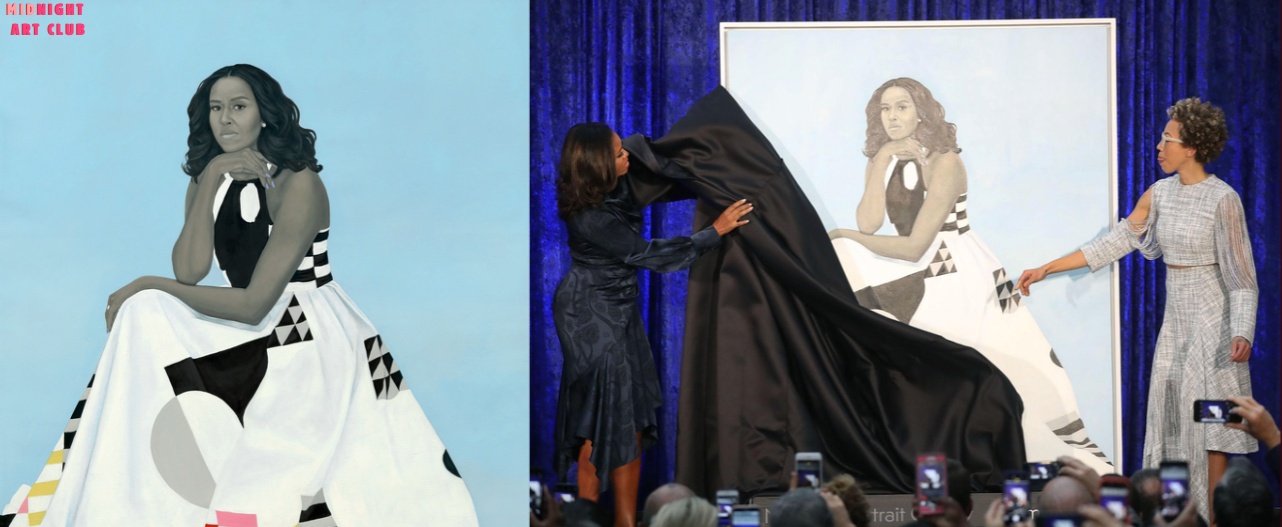
Why? Because it didn’t match the “expected” image of a First Lady. No grand decor. No heavy symbolism. Michelle Obama is seated, calm, almost silent. Her gaze is direct. The geometric dress stands out against a pale background. And above all: her skin is painted gray.
Sherald has used this gray for years. Not to “erase” skin color, but to disarm our automatic racial reflexes. By removing realistic color, she forces us to look differently: at posture, presence, individuality.
What makes Amy Sherald’s work deeply political isn’t provocation. It’s her stubborn insistence on who deserves to be seen. She paints Black, queer people, people from minority communities, in calm, dignified, almost ordinary poses, the exact opposite of the spectacular or tragic images to which American history has so often reduced them.
Her exhibition at the Whitney Museum of American Art made this coherence clear: portraits of ordinary people, neither heroized nor victimized, but fully present. Through them, Sherald makes a simple yet radical statement: these bodies, these faces, these identities belong in the official narrative.
Takeaway: sometimes, simply insisting on presence is already a political act!
THE GOSSIP - When silence is cheaper than courage
Lately, however, things have become more complicated.
During the tour of one of her exhibitions, the Smithsonian National Portrait Gallery reportedly expressed hesitation about showing a specific work: Trans Forming Liberty (2024). Officially, nothing explicit. Unofficially: fear of political backlash and above all, fear of losing public funding, in a climate that has grown increasingly tense under the current administration.
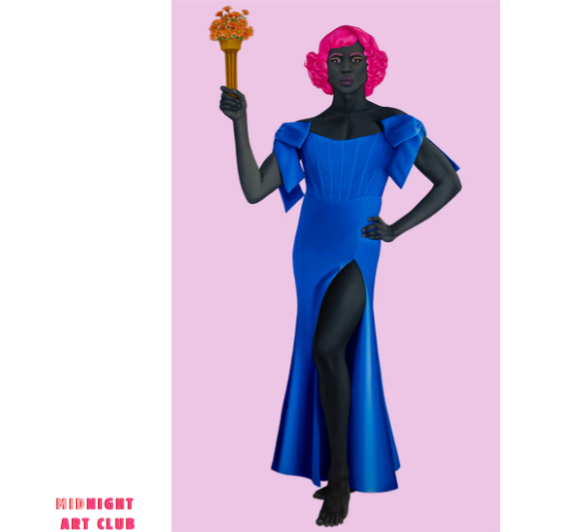
Rather than agreeing to remove “just a work” Amy Sherald made a very clear choice: she withdrew the entire exhibition from the museum. Her message was simple:
If my work has to be amputated to reassure funders, then it doesn’t belong here.
What’s striking is what this decision reveals about the current political climate.
The targeted work depicts a transgender person, an identity now explicitly targeted by parts of the American political class. Restrictive laws, hostile rhetoric, and symbolic erasure all contribute to reducing trans visibility in public space.
In that context, removing these works from an exhibition isn’t a neutral curatorial decision. It actively participates in this erasure. Fewer images, fewer stories, fewer faces on museum walls, even though museums are supposed to be spaces of representation and debate.
The most unsettling part is that this wasn’t the result of official censorship, but of anticipated fear: the fear of losing funding, of triggering controversy. In other words, art is restricted before it is even attacked.
Full story here.
NOS RECOS DE LA SEMAINE
in New York:
Museum: Untitled (America), Whitney Museum, on continuous view
A journey through America via the Whitney’s collection, featuring artists such as Félix González-Torres (yes, the candy piles), Jasper Johns, Georgia O’Keeffe, Alma Thomas, and Edward Hopper.
This fragmented America, made of multiple, sometimes contradictory narratives, strongly echoes Amy Sherald’s work. Who gets to appear? And who gets to be considered “American”?Gallery: Dan Flavin, David Zwirner, through February 21, 2026
Dan Flavin and his neon lights. Nothing else and yet everything changes. Light cuts through space, colors the walls, and forces you to slow down and become aware of where you stand. Minimal, yes, but never cold. A perfect reminder that minimalism isn’t an abstract idea; it can be a physical experience.
in Paris:
Museum: Martin Parr: Global Warning, Jeu de Paume, through May 24, 2026
One of the best exhibitions I’ve seen recently. A sharp mirror of our modern obsessions (tourism, consumption, collective anxiety) both funny and visually striking. Parr never moralizes: he lets us recognize ourselves, while smart, accessible mediation ties the images together beautifully.Gallery: Barkley L. Hendricks: All is Portraiture, Galerie Marian Goodman, through April 4, 2026.
OPENING: Friday, February 6, 6-8pm
Portraits (yes, portraits again) built around two media that are too rarely brought together: photography and painting. Hendricks (1944–2017) is best known for his portraits of Black Americans, rendered with style, precision, and a real sense of sovereignty. This is his first solo exhibition in Europe, and it resonates all the more as a tribute to Marian Goodman, who passed away on January 22, 2026.
to listen to:
Podcast: Amy Sherald, I Painted Michelle Obama, Toure Show
A very down-to-earth conversation about what it changes, in an artist’s life, to paint a portrait that instantly becomes “historical.” She talks about her choices, color, pose, intention, without any fluff. Perfect to listen to after reading this week’s episode.
See you next week… same day, same time!
Juliette
To get in touch : info.midnightartclub@gmail.com
...
Midnight Art Club - Art, Unfiltered
Midnight Art Club - Art, Unfiltered